
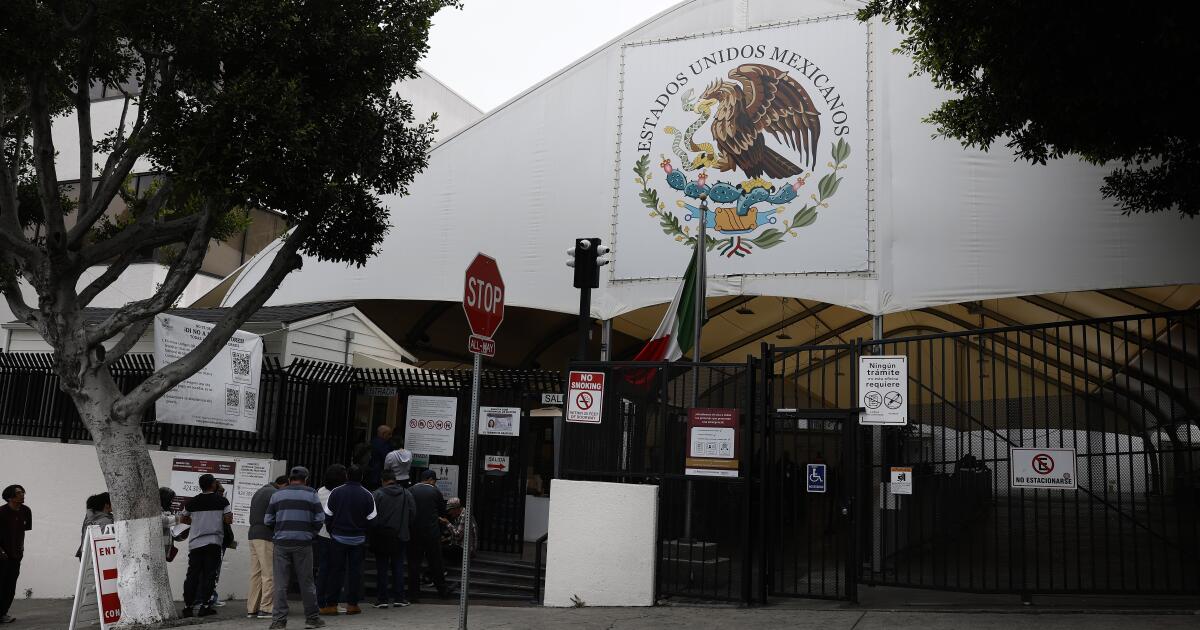
The Mexican Consulate General in Los Angeles helps thousands of citizens register their births and obtain passports every week, and since the start of President Trump’s second term, loved ones who have violated his administration’s immigration policies have had increased access to legal assistance.
Serving the country’s largest Mexican community, all 53 Mexican consulates in the United States provide services that make life easier for Mexicans, just as the nine U.S. consulates in Mexico improve the lives of Americans south of the border.
The U.S. State Department has launched a review that could lead to the closure of an unspecified number of Mexican consulates. The reasons for the review have not been made clear, but the review comes amid a crackdown on immigration, thorny bilateral issues, and far-right theories that the consulate is interfering in U.S. politics and encouraging Mexicans to migrate north.
Azucena Avilés, a 33-year-old mother who drove more than an hour to the Los Angeles consulate this month to renew her Mexican passport and obtain one for her daughter, said consular services are invaluable. California in particular is home to nearly 13 million people of Mexican descent, including an estimated 1.7 million who are in the U.S. illegally.
“It would be unfair if they interfered with our support system that is provided by Mexican citizens, especially the Mexican consulate, to help and protect our fellow Mexicans in any way,” she said.
President Trump has increased pressure on Mexico, raising questions about human rights, national sovereignty and regional diplomacy.
The administration has only provided broad explanations about the start of the review.
“The State Department constantly reviews all aspects of U.S. foreign relations to ensure they align with the President’s America First foreign policy and advance U.S. interests,” Dylan Johnson, assistant secretary of state for international affairs, said in an email.
A possible reason for the review is that it could somehow fit in with the Trump administration’s immigration policy of illegally deporting people in the United States. The largest group of such people is Mexicans, an estimated 4.3 million people, according to the Pew Research Center.
Relations between the two countries could also be affected, with President Trump ramping up pressure on Mexico in the lead-up to free trade negotiations important to both economies, taking a more aggressive approach toward the U.S.’s southern neighbor and threatening military action against Mexican cartels.
Mexican President Claudia Sheinbaum has avoided a direct confrontation with Trump and instead relied on diplomacy, sending senior government officials to Washington and seeking to maintain strong ties with the Trump administration by cracking down on Mexican cartels. Mr. Sheinbaum and his predecessors were also key collaborators in slowing immigration to the United States and accelerating deportations of other Latin American immigrants.
But Mr. Sheinbaum took a firmer stance on the deaths of Mexicans in U.S. immigration detention centers, calling them unacceptable and saying conditions in such detention facilities are “contrary to human rights standards and the protection of life.” She directed the Mexican consulate to visit detention centers daily to ensure that detained nationals are being held in a safe environment.
Relations have sharply deteriorated in recent weeks after the United States indicted several Mexican officials on drug trafficking charges and after two CIA agents were killed after an anti-drug operation in northern Mexico. Scheinbaum said the government had not authorized U.S. involvement. The drug investigation has raised uncomfortable questions in Mexico about the extent of U.S. involvement in internal security operations.
Years of retaliatory tariffs between the two countries are also adding to the burden.
Former Mexican Ambassador to the United States Arturo Salcan said foreign consular reviews “usually indicate that bilateral relations are in a very difficult period,” and that given all the current issues, Mexico is at the “worst period in U.S.-Mexico relations” in decades.
Further straining relations are theories amplified by Peter Schweitzer, an author with a pro-Trump following, who claims the Mexican consulate is meddling in U.S. politics and encouraging migration to the United States. Experts say that while some Mexican consular officials may have tried to influence politics in their home country, there is no evidence that they interfered in the U.S. election.
In response to the State Department investigation, Mr. Sheinbaum said the idea that the Mexican consulate is “playing politics in the United States” is completely false. She said the job of consulates, wherever they are, is to “always protect” their citizens.
Sarkhan also said the consulate protects the rights of Mexican citizens, but there is no evidence that it is interfering in U.S. elections.
Whatever the reason for the consulate’s review, it is stirring up anxiety.
At a weekly public forum at the Los Angeles Consulate General, an anonymous woman whose husband was in U.S. immigration detention asked for help finding a lawyer for her husband, highlighting one of the important services consulates provide to citizens.
The older man said he had heard about the review and asked about the possibility of closure.
Mexico’s top diplomat in Los Angeles, Carlos González Gutierrez, responded that there was “no reason whatsoever” for the United States to close the Mexican consulate, as Sheinbaum said.
In fact, consulates will have a significant and devastating impact on Mexican immigrants, especially in remote areas,” said Ariel Luis Soto, senior policy analyst at the Migration Policy Institute.
Consular officials visit the Immigration and Customs Enforcement holding center in downtown Los Angeles every day to identify Mexican detainees and interview as many as possible.
González Gutierrez, 62, begins his weekly public forum by pointing out how many Mexican consular officials he has met since the immigration crackdown began in Los Angeles last June.
At the May 11th meeting, the number was 1,940. He said nearly half had deep roots in the United States. About 46% were deported, 35% had children born in the U.S., 69% entered the country through a port of entry, 6% overstayed on a visa, and 2.5% applied for asylum. Most were men, and many worked in construction, agriculture, horticulture, and service industries.
He also disputed claims that the Mexican consulate interferes in U.S. politics.
“We are guests of this country’s government in the same way that the U.S. consul is a guest of the Mexican government. In that sense, we are not activists or spies,” González Gutierrez said. “We operate openly in a pluralistic and democratic society.”
Pineda and Janetsky contributed to The Associated Press. Janetzky reported from Mexico City.
#overhaul #Mexicos #consulate #raises #concerns #vital #services #lost