
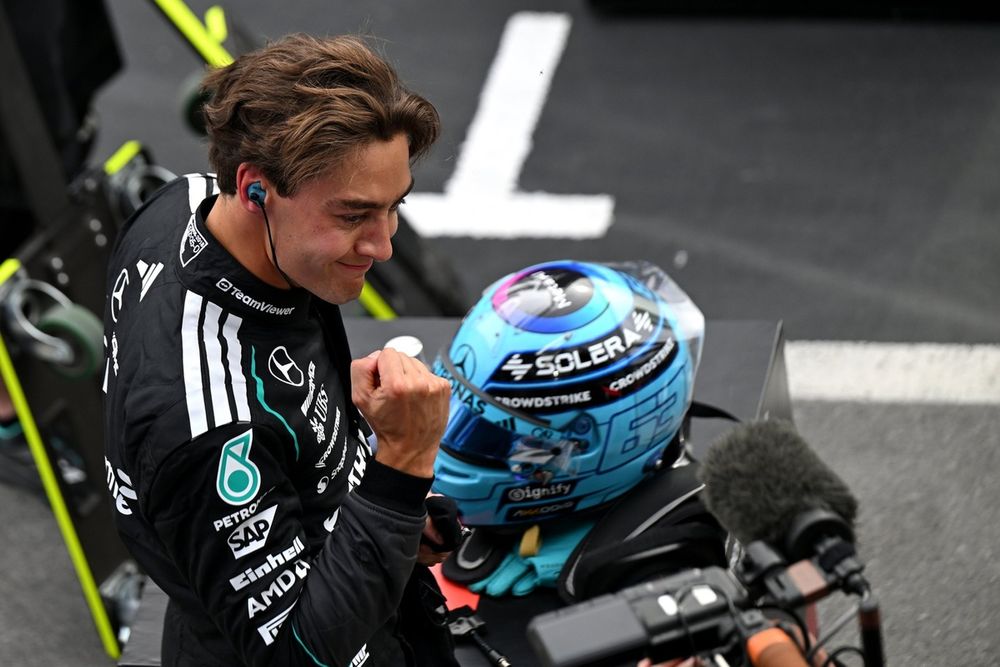
How can you unravel the difference between teammates that is less than the average blink of an eye? In final qualifying for the Canadian Grand Prix, the difference between George Russell and Kimi Antonelli was 0.068 seconds. Although the margin was close, its significance can be gauged by the jubilation that Russell sent over the airwaves when he learned he had won pole position.
In the end, Antonelli did two preparation laps and one push lap in his crucial second run, while Russell essayed two push laps, separated by one at a lower tempo, leading to the often depressing subject of tire preparation. With this much white space, it’s easy to come up with an explanation that fits your agenda. That tends to make for a hot take for the many former drivers who are now making big bucks as professional TV analysts.
Sky Germany’s Ralf Schumacher was one of them. “Kimi was faster, and for him to be that close to George in just one lap was a very strong performance.”
Beneath this seemingly contradictory statement – if Antonelli had been faster, he would have put the car in pole position – there is an interesting proposition. Mercedes boss Toto Wolff was aiming in a similar direction, but in a more subtle way.
“I don’t think we gave them the top car in qualifying today,” he said after the session. “I found that we only managed to get things together in the final moments. We weren’t balanced.”
“George saved himself those two laps by getting his balance up and warming up the rear, and then Kimi missed a downshift, which meant he missed one gear on a fast lap, and that was exactly where he lost the lead.”
Russell mastered tire temperature management during qualifying, setting up a late charge to pole position
Photo credit: Sam Bagnall / Sutton Images via Getty Images
Tire temperatures and the difficult task of balancing them across the front and rear axles greatly influenced the mood of all drivers in the media ‘pen’ after qualifying. For those who contrived to switch on both axles at the perfect time, there was a warm glow that the job had been successfully accomplished. Those who didn’t find their sweet spot were evident by the melancholy that accompanied them.
The Canadian Grand Prix will be held a month early this year, but Montreal is presenting mixed weather conditions in late spring. Of all the venues on this season’s calendar, this one has the greatest difference between high and low temperatures throughout the day. Add in a low-grip surface and a track layout where most corners are completed in a relatively short amount of time, and you have the perfect conditions for a downward spiral.
Low grip means less heat transfer to most of the tire, making the driver feel unable to push. When this happens, there is a tendency to slip, the surface temperature increases temporarily without being transferred to the core, and on the straights the temperatures in the front and rear sheds increase at different rates.
Antonelli had the advantage in sector 1.
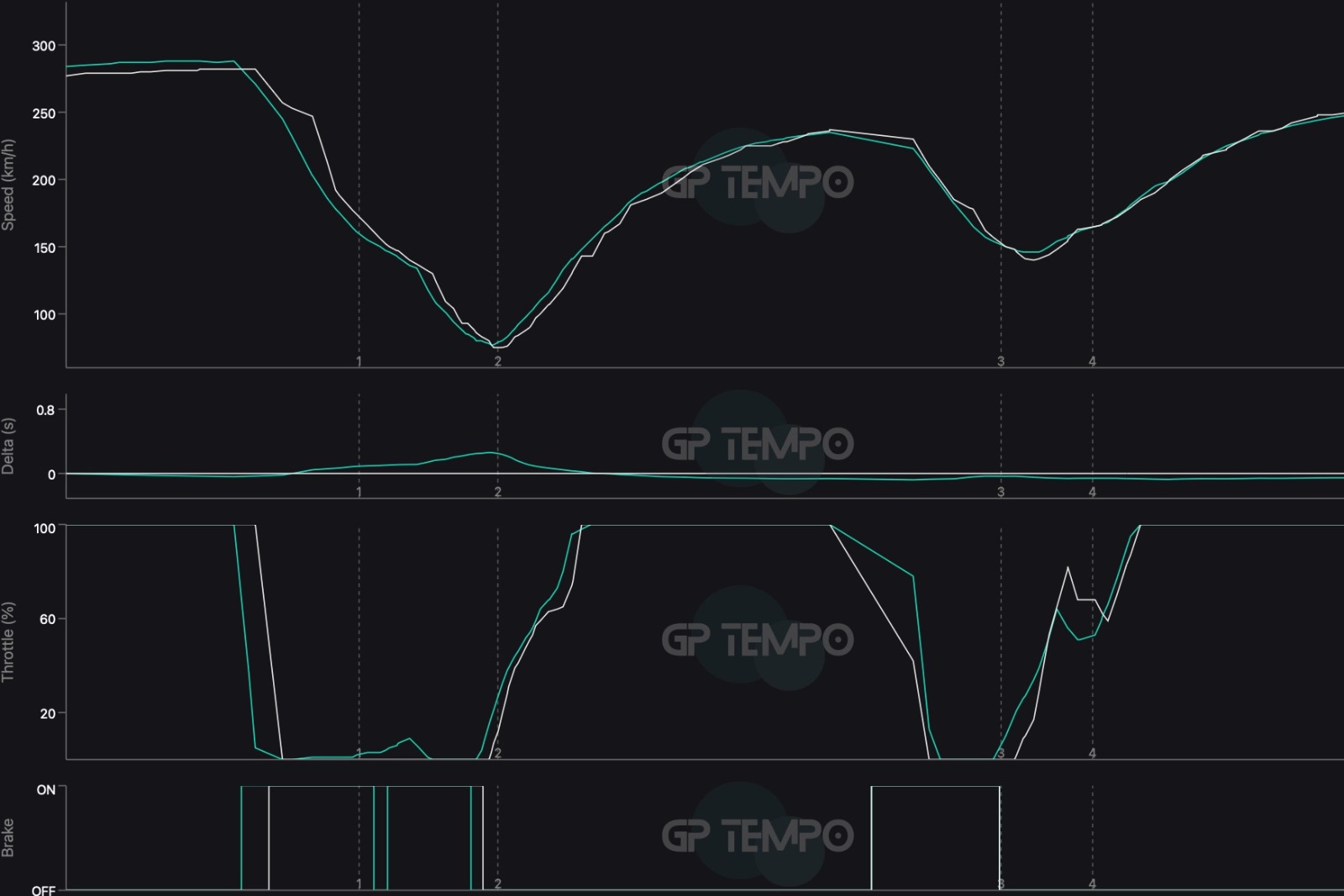
Telemetry analysis of Mercedes drivers’ fastest laps shows some interesting contrasts in style. You might think that Antonelli (light blue trace) was the last car to brake late, but in reality Russell (white trace) was slightly behind, braking into Turn 1.
Graphs showing the time difference between two drivers often reach unnatural-looking peaks in corners like this, based on the transient speed offset of one driver braking later. Russell had a gap of about a tenth of a second over his teammate at this point, but Antonelli overcame that gap with a clean start from Turn 2, and decisively opened the throttle early, which turned into a speed advantage down the straight.
Antonelli then entered the quick chicane of Turn 3 later and removed the throttle less abruptly, but the braking phases of the two Mercedes drivers here were almost identical. That was enough for Antonelli to maintain an advantage of just under a tenth of a second and take the purple sector.
Russell gains advantage in sector 2
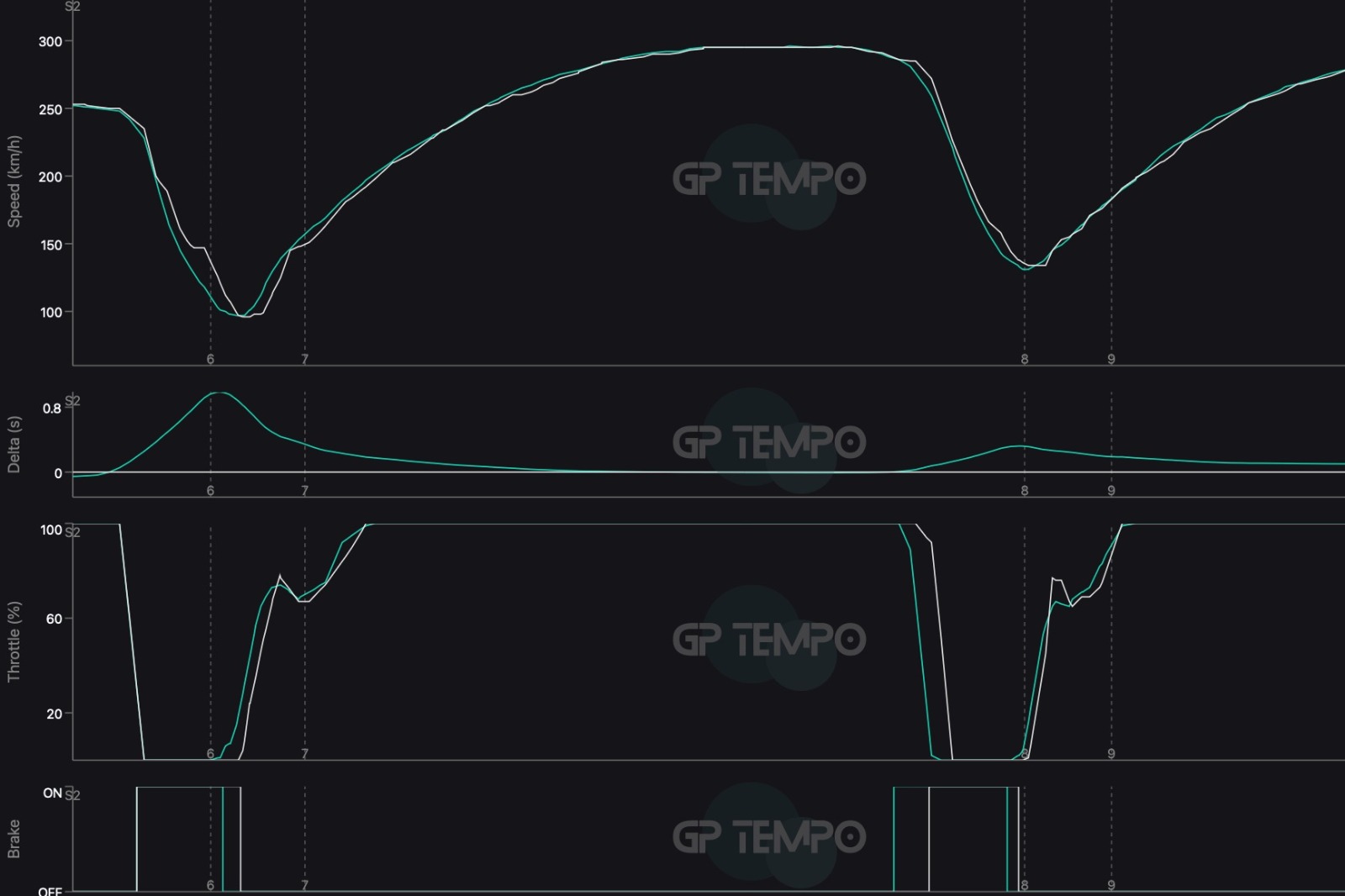
Turn 6 is where the balance changed, albeit by just a few milliseconds. This could probably be where the downshift failed, or more precisely where the selection was rejected after a delay of about a tenth during the braking phase. It’s difficult to be precise without more details available to the team, but our data shows that the process of gearing down from 6th to 2nd gear is different, with Antonelli spending more time in 5th gear.
Both drivers braked at the same point, allowing Russell to make more speed on this sharp curve, but again, without access to more detailed data, it is impossible to conclusively distinguish the effects of Russell’s superior tire grip from the disruption caused by his slightly delayed downshift. What we can see is that Antonelli hit the gas a little earlier from the brakes and by the time he fully accelerated (using the electric boost) out of Turn 7, he had limited the damage to about 600ths.
On the sixth lap of the sprint race, in Turn 8, where Antonelli took out his frustrations (with the help of road irregularities), he was much more cautious than Russell, blending from throttle to brake noticeably early in the data, producing another gradual spike in the delta graph. He also braked early, but Russell was able to get through the corner at top speed. Corners are one of the great exercises in F1. That said, at the end of the lap the outer borders of the grass were more forgiving than the ‘Wall of Champions’.
This gave Russell a tenth of a second up and he recorded a purple sector as he entered the final stages of his lap.
Antonelli fights back, but it’s not enough.
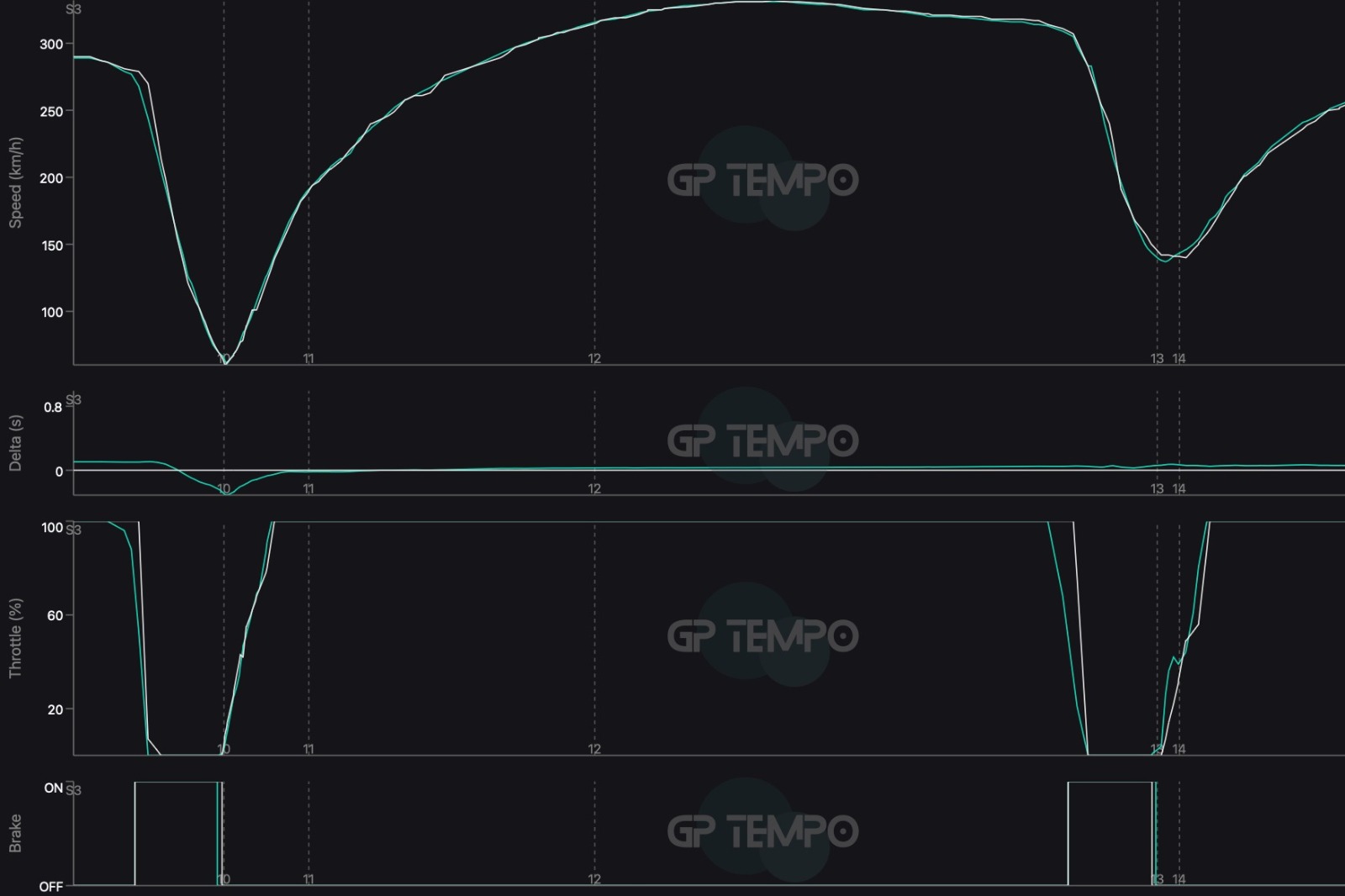
There are only two actual corners in Montreal’s Sector 3: a hairpin and a chicane, but they are justifiably infamous. At the hairpin of Turn 10, Antonelli eased off the throttle a little and took a cleaner approach, sacrificing some of his speed on the turn-in to pass the apex softer and faster, successfully closing down Russell by about six-hundredths of a second, who had braked at the same point but throttled later and sharper.
The throttle and speed profile is about the same coming out of the hairpin and along the straight afterwards. At this point, Russell was only five-hundredths ahead of his teammate and went on to pick up nearly two more points at the final chicane of Turns 13/14. Again I braked at the same point as my teammate, but released the throttle much later and more abruptly to get the car to turn faster on the approach.
“That last lap came out of nowhere,” Russell said. “And it was such a challenging session that it was a really great feeling when you had to put everything together on the last lap to get on the leaderboard. It was epic. I wasn’t as obviously ahead of everyone else as I was yesterday, so it was definitely a challenge. I redialed my driving for the last lap and managed to pull it together.”
Mercedes made the task facing its drivers even more difficult by employing set-up changes to theoretically put the car in better shape for the cold and wet conditions expected on race day. “It might hurt a little bit right now,” Russell said. “That caused the car to be a little out of sync.”
Early in Q3, Russell oversteered in Turn 6 before coming off a push lap and immediately pitted for new tires. Being out of sync with his rivals gave him the luxury of taking a slightly different approach for the final run, but with no ‘bunker’ laps on the board it was a high-stakes effort.
The fickle effects of tire temperatures were well illustrated by Isaac Hajjar, who led in Q2, but seemed to struggle in seventh place in Q3, only to clock another four-hundredths of a second, with Russell almost half a second faster.
Whether Antonelli would have been faster overall if the tires were closer to optimal is a matter of speculation, but he was certainly faster in two of the three sectors. And he certainly believes it was in him.
“Of course there was still a little left, but George did a great lap,” Antonelli said after the match. It is a subtly reciprocal praise, and perhaps frisson In the air between two teammates after a sprint race event.
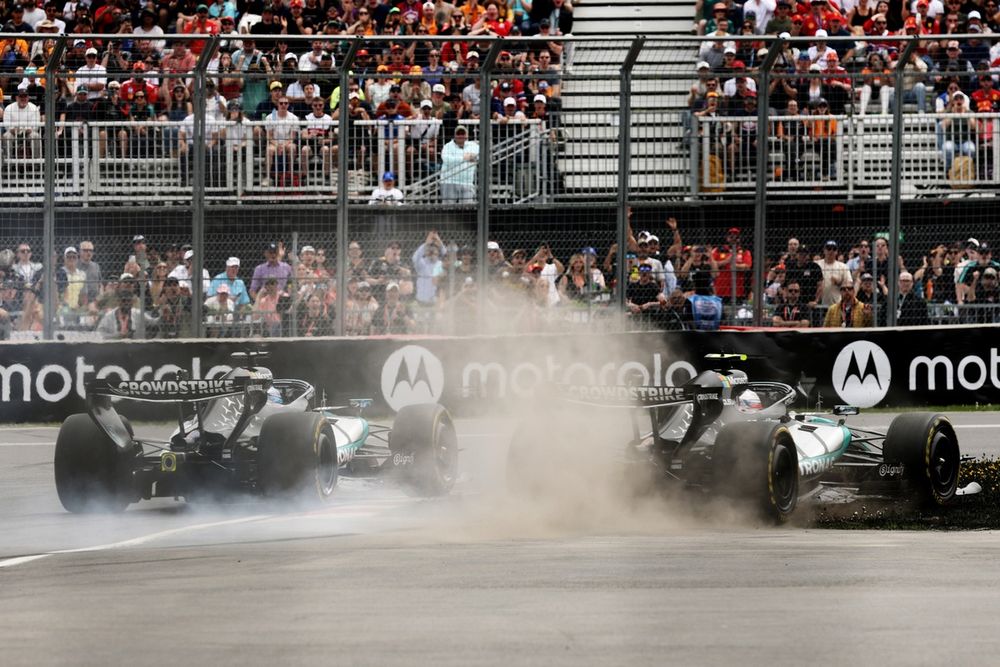
Full focus will be on how Russell and Antonelli will be involved in the Grand Prix after they collide in the sprint
Photo credit: Mark Thompson/Getty Images
We would love to hear your thoughts.
Please tell us what you expect from us in the future.
Please help us with the survey
– Autosport.com Team
#fine #line #denied #fast #Antonelli #Canadian #qualifying