
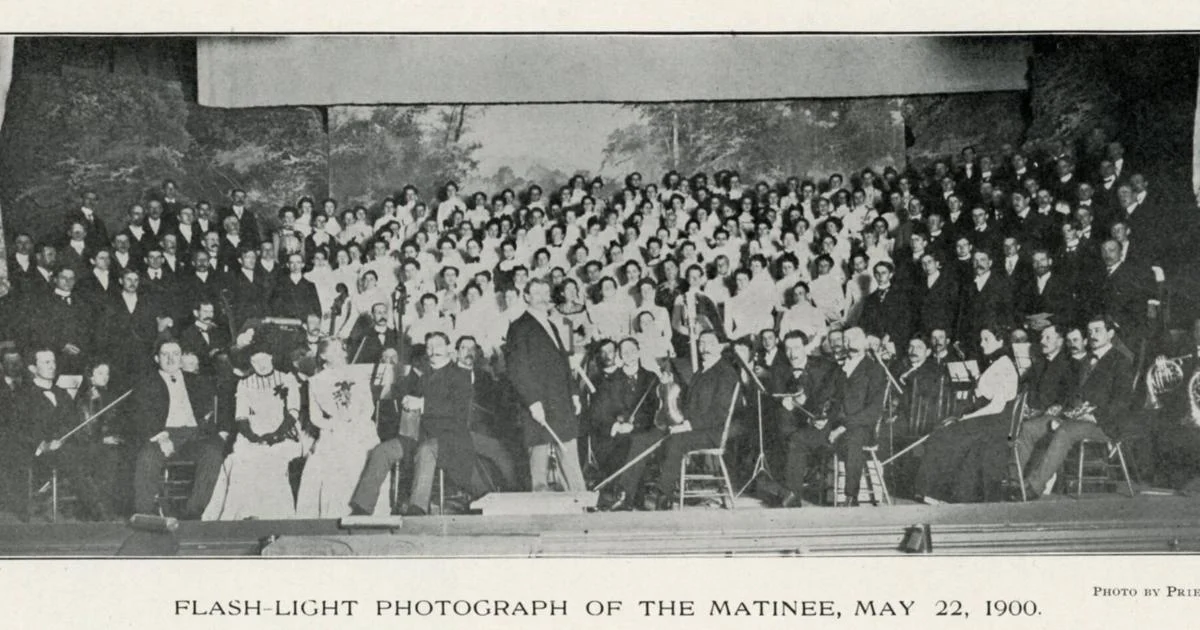
The 16th Geneva Music Festival is underway, bringing world-class artists to the city. This is not the first event to do so. The annual festival of the Geneva Choral Society was held from 1895 to 1923.
Although the current festival was started by Geoffrey Heard, Hannah Collins and Elliot Heaton, the Choral Society was a community organization.
According to its 1903 history, the choral society began as a casual conversation. While visiting music professor PD Aldrich in Rochester, Mrs. Clapp and Mrs. Moore lamented the lack of a choir in Geneva. “Professor Aldrich, with characteristic alarm, replied: ‘Nothing is so simple as this. Gather forty names, call a meeting, elect officers and conductors, and look at your society!’
The first meeting was held on May 2, 1894, in the chapel of the First Presbyterian Church. Forty-five men and women signed on as charter members and paid “the amount of $2.00 each for 10 lessons taught by Mr. Parley Dan Aldrich.” Throughout its history, the association has emphasized trained vocal performance. The enthusiasm of the members can be seen from the fact that they held their first concert in late June.
In 1895, the Society held its first annual May Festival. The advertising flyer announced that it was “The Great May Festival, organized by the Geneva Choral Society, the largest music festival in the history of Geneva.” Singers from Rochester and Ithaca joined local members to form a “great trained choir of one hundred and fifty voices.” The Society performed matinee and evening performances at the Smith Opera House with a 20-piece orchestra.
The festival continued annually until 1917. The 1904 program booklet told a story familiar to all local arts groups. “Indeed, there were lean years as well as bumper years. There were years when only a penny remained at the bottom of the association’s wallet…But such serious embarrassments now seem to be in the past.”
The association was not without drama. In January 1904, a leaflet was printed by the “Friends of Justice and Members of the Geneva Choral Society” titled “The Division of the Geneva Choral Society.” Professor Richard Sutcliffe had led the association for many years, but opponents wanted to replace him. Mr Sutcliffe was voted out by the board. After outlining the facts, the leaflet concludes: “The choir is almost solidly behind Professor Sutcliffe and is extremely upset by the board’s actions. A number have indicated their intention to resign or withdraw their pledge.” [he] is maintained…the choir may end up in chaos. ”
Featuring big names
For its first 20 years, the festival employed soloists and musicians from the region, sometimes from New York City. Then it began to attract famous soloists. A later program history notes: “In 1914[the festival]took a major step forward, realizing that the opera house it had protected for so many years had outgrown its size, and held a gala concert in the state armory. That year it abandoned its orchestra and secured the services of two of the world’s greatest artists, Mrs. Schumann-Heink and Mr. Reinald Wellenrath.”
Reinald Werrenrath (August 7, 1883 – September 12, 1953) was an American baritone opera singer. He made hundreds of records, toured extensively, and was a regular on radio shows.
Ernestine Schumann-Heink (June 15, 1861 – November 17, 1936) was a Bohemian-born German-Bohemian-Austrian-American operatic contralto known for his vocal flexibility and wide range. Unlike Wellenrath, she was known for her opera performances.
In 1915, famous artist Alma Gluck and tenor Evan Williams performed at the Methodist Church.
Alma Gluck (May 11, 1884 – October 27, 1938) was a Romanian-born American lyrical soprano. Her first success was at the Metropolitan Opera in New York City, but she later performed throughout the United States and became an early recording artist.
Harry Evan Williams (September 7, 1867 – May 24, 1918) was an oratorio tenor. He recorded approximately 100 78 rpm records for Victor Talking Machine Co. in the United States and The Gramophone Co. (His Master’s Voice) in England. Praised for his interpretations of Handel, Williams has given more than 1,000 performances and recitals throughout the United States, England and Wales during his 25-year career.
Other artists who joined the Geneva Choral Society included contralto Christine Miller and tenor Paul Althaus, who performed with the Philadelphia Orchestra, and Leopold Stokowski at the Armory in 1916. In 1917, the Chicago Symphony Orchestra performed with Wellenrath, who was joined by soprano Grace Kearns. In 1922, the Cleveland Symphony Orchestra appeared with Rochester’s soloists.
Geneva Daily Times Publisher WA Gracie organized vocal concerts and festivals. The two artists he brought to Geneva were soprano Alma Gluck and contralto Louise Homer. The two women performed at the Metropolitan Opera and recorded popular songs for Victor. They duetted on several Christian hymns, including “Abide with Me,” recorded in 1913.
Gracie’s collection includes several scrapbooks dedicated to the Choral Society (founded in 1894), which illuminate the problems posed by the First World War. The group was very popular before the war, but had to cancel concerts in 1918, and a revival in 1921 failed in 1923. Assistance was sought from the Geneva community, but not enough support was received and the choral society was abolished.
#Geneva #Choral #Society #flourished #early #20th #century